Entries Tagged 'learning' ↓
November 20th, 2008 — Entrepreneurship, learning
What is Visual Thinking?
Visual thinking is our brain’s natural way to solve problems creatively. We picture the problem and its various outcomes in our mind’s eye. Ancient humans doodled solutions to their problems on cave walls. But in today’s world—especially in business situations—we’re in the habit of making lists, outlines, and spreadsheets, using only one dimension of our brains.
Visual thinking taps into multiple brain centers, getting us to the heart of the problem more quickly and helping us use creativity to solve problems, manage projects, streamline processes, communicate information, and gain buy-in from team members.
What are Mind Maps?
A mind map uses visual thinking to create an organized display of the plan, problem, or project—a diagram that mirrors the way our brains naturally processes information. Information and tasks radiate out from a central theme or goal, rather than falling below a header, as in a list. Related items link with connecting lines. New items can be captured randomly and then organized into the larger scheme, with new ideas flowing naturally as the map gains detail. Information can be illustrated with symbols, words, color, images, links, and attachments to add context, helping to reveal new directions, greater clarity, and big ideas.
A mind map works the way the human brain works, aided by a powerful graphical process. It frees the mind to think, visualize, and understand in ways that go beyond multi-paged linear documents. So when we need to brainstorm, plan, learn, organize, save time, improve recall, and manage the details of a complex life, a mind map is a great place to do it all.
I am still very much enthused by the use of mind maps which this week again has been of great help to me. You will recall over 2 years ago, I mentioned in my blog Tony Buzan’s contributions to Mind Mapping.
November 15th, 2008 — books, Entrepreneurship, learning
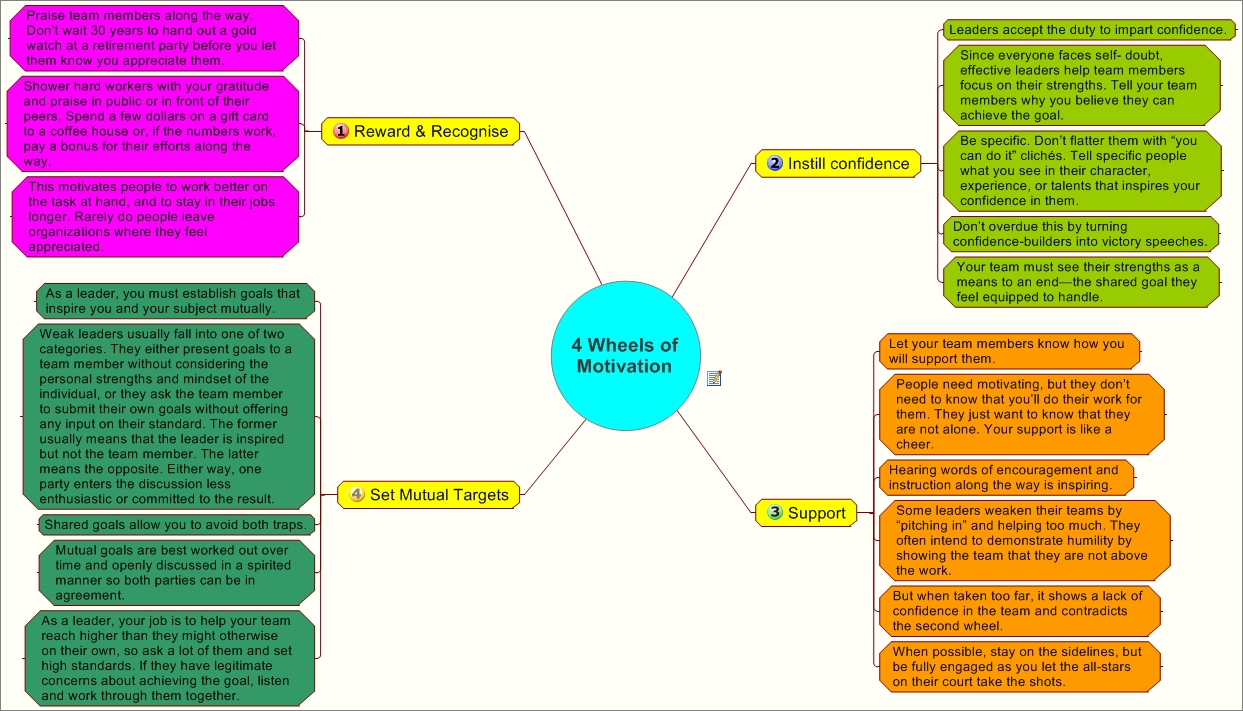
Dave Durand discusses the 4 wheels of motivation. To build sustained results he reckons : leaders should set mutually agreed goals, instill confidence & trust, give support the team, and offer reward & recognise.
( Click on the image to enlarge) I have produced a mind map which captured my reading.
November 14th, 2008 — Entrepreneurship, learning
At the meeting when I addressed the bunch of business leaders this week, I insisted on the importance of communication. It was item4 on my list of hi- 5. ‘Seek first to understand than to be understood’, Stephen Covey used this very catch phrase to introduce communication in his widely read book, ‘the 7 habits of highly effective people’.
I had the chance of having read and studied the Covey Leadership literature when I was being trained in Utah as a certified trainer. Having shared the material so often, with the number of participants of the subsequent Covey Leadership seminars, the principles, through repetition, have sunk in me. Yet another example that ‘through giving one recieves’.
Some tips on communication from Dianna Booher, the 10 C’s of communication:
Information is not communication. Posting announcements, holding teleconferences, or scheduling meetings is not substantive communication.
Poor communication! We hear this complaint often. The problem? Information is not communication. Posting announcements, holding teleconferences, or scheduling meetings is not substantive communication. These 10 strategies will help you deliver a message that informs and encourages others while gaining buy-in:
1. Be Correct. Tell it like it is. From the C-suite to the mailroom, truth-telling is key to productivity. If you missed your numbers, say so. If you made a mistake, admit it. Be known as a person who speaks the truth. There are easy answers. And then there are truthful, more difficult answers. Your power as a communicator often depends on your choice between the two.
2. Be Complete. Don’t get so busy analyzing, solving problems, questioning, coordinating, deciding, and delegating that you fail to communicate what’s going on to those on the sidelines. To make good decisions and take appropriate action, people need complete information. Great leaders give people the why’s, what’s, and how’s.
3. Be Clear. Be specific. Separate facts from opinions. Verify assumptions. Vague generalities create confusion. Speak and write in simple, plain language. Muddling information creates a sense of phoniness, insincerity, or intimidation. Purposeful evasion—where harmony is valued above honesty—destroys trust, erodes morale, and lowers productivity. In such cultures, everyone gets along, goes along —and sinks together. Face-saving is a poor substitute for problem solving.
4. Be Consistent. A manager hears, “The company is not doing well. Freeze wages.†Then she sees construction crews remodeling the executive dining room. Customers, colleagues, and employees experience disenchantment when they see inconsistencies in the workplace. You can’t not communicate—by words, action, or silence. You communicate by the policies you enforce and ignore, by the behavior you reward and penalize, and by the quality of the products and services you advertise and actually deliver.
5. Be Credible. Consider the look, language, likeability factor, character, and competence. People often judge your credibility by your appearance (dress, grooming, movement, gestures, facial expression, posture, walk). When you speak, they judge your ability to think on your feet and express yourself. People tend to trust people they like.
6. Be Concerned. Concern connects people. In whatever situation—from product recall to layoffs to employee illness to accident victims to stressed colleagues—there’s great power in communicating your concern. When logic causes a lapse in the relationship, emotion closes the gap.
7. Be Connected. Leaders who show they care about people as individuals—not as employees, suppliers, or customers—make a connection. Those who don’t fail to communicate, and lose employees and customers.
8. Be Current. Speed is the new measure of quality. No one wants to wait days to hear the latest big news. Speed is essential in bringing scattered work groups up-to-date on new projects, diffusing rumors, and maintaining morale.
9. Be Competent. Ensure your communication demonstrates competence. People hear what you say or see what you write about your work. Often they judge your competence by what you communicate—your reputation with customers or colleagues often rests on a single interaction.
10. Be Circular. Ask, “Who else needs to know?†when there’s a change of plans or when new ideas surface. Publicizing your point, encouraging feedback, facilitating conversations across functions are just a few ways to be circular in your communication.
Communication is the most critical component of great customer service, the biggest challenge leaders experience in times of change and upheaval, the most frequent reason top talent joins a new team, and the most frequent complaint employees cite as their reason for leaving.
How well you communicate dictates how well you do as a leader.
September 29th, 2008 — Entrepreneurship, learning, NLP
For centuries, three factors have driven economies: land, labour and capital.
Now there are three new big “drivers”:
· Ideas.
· Brainpower.
· Information . . . especially scientific information. (From Gordon Dryden author of the learning revolution)
Is there a method to be more ideas and be more creative?
What is creativity? Professor Robert I Sutton of Stanford University says creativity is simply making new things out of old ones.
How to think for great ideas
AÂ program to teach yourself creative thinking
An idea defined: a new combination of old elements
1. Define your problem
2. Define your ideal solution and visualize it
3. Gather all the facts
4. Break the pattern
5. Go outside your own field
6. Try various combinations
7. Use all your senses
8. Switch off – let it simmer
9. Use music or nature to relax
10. Sleep on it
11. Eureka! It pops out
12. Recheck it
From my NLP training Robert Dilts proposes from his book SKILLS FOR THE FUTURE the S.C.O.R.E. model for managing creativity and innovation.
|
`
|
|
|
|
|
|
|
|
|
|
Symptoms
|
|
Causes
|
|
Outcomes
|
|
Resources
|
|
Effects
|
|
The most noticeable & conscious aspects of the present state or problem state
|
|
Underlying elements responsible for creating and maintaining symptoms
|
|
Desired states or goals that take the place of the symptoms
|
|
Elements responsible transforming causes and symptoms creating and maintaining out comes /effects
|
|
Medium to long term responses to, or results of, achieving an outcome
|
|
I
|
|
I
|
|
|
|
I
|
|
I
|
|
More or less constant over time
|
|
in general less obvious than symptoms
|
|
|
|
Techniques/ operations
|
|
Positive effects reasons for, or motives for, the outcome
|
|
|
I
|
|
|
|
I
|
|
I
|
|
|
More or less remote origin in time
|
|
|
|
Structures sequences for applying resources
|
|
Negative effects: create resistance ecological problems
|
|
|
|
|
|
|
|
|
|
September 27th, 2008 — Entrepreneurship, learning, Uncategorized
Since yesterday I dwelt on my reading on learning and progressed to the future challenges in this field. A panel of reputable education leaders has concluded that we have to connect education theory with the ideas of uncertainty and faith that are the pathway to creativity and innovation and all our futures. I have extracted part of their paper of interest to me.
A Future of Transformation– Difficult by Nature
History is a chronicle of humanity’s drive for progress to overcome adversity and to find meaning. New forms of learning practices have been central to the concept of shifting and transforming from one type of society to another.
The scientific method emerged as a new learning concept in the 18th century as learning needs shifted from a speculation about the metaphysics of God to observation and analysis of nature’s reality. Reducing complex reality to its most elemental parts had become the basis for learning as the secrets of nature were revealed in the new natural sciences of physics, chemistry and biology.
For two hundred years, learning has occurred through the struggle of thousands of scientists, geologists, psychologists, managers and technologists. Every story of discovery, invention and new business methods has been the result of the persistence and dedication of individuals who revealed a passion to advance knowledge and human progress. Whether it was Edison’s artificial light, Pavlov’s dog who showed how animals and humans can be conditioned, or Mendeleev’s early study of genetic characteristics of plants, all significant advancements of knowledge have not come easily.
Today is no different, even with the advent of technologies that allow us to investigate more complex realities and plumb the depth of ideas that would have been considered magic a century ago. A search for excellence and discovery of new knowledge still takes a level of commitment that only those with a passion for learning have.
Thriving on Difficulty
The Industrial Age is ending with the realization that we are in a third transformation of history, equally as important and difficult as was the shift from the Agricultural Society to that which became known as the Commercial Society.
There are three significant differences that slowly are becoming apparent that must be recognized and resolved if we are to thrive and collaborate with others to maintain a sustainable and vital society:
1) The concepts of independence, linear thinking and self- interest are transforming into organizing principles of interdependence, non-linear thinking and helping each other succeed.
2) Work has been shifting from physical to mental.
3) Western Society finds its core goals no longer centered on experimentation, risk and the joy of discovery and creative innovation, but on that of being conservative, finding identify through materialism and looking to meet individual needs in the cheapest and easiest ways.
It is this third significant difference that potentially will create the most challenging change to the future of our society. Attaining material affluence and supporting individual rights emerged as the result of people who were committed to making a better world for their grandchildren, often as a result of religious beliefs. A key value was to do whatever was necessary to give life more meaning for those who were to come after, no matter how difficult.
Today, the concept of thriving on difficulty has been lost as an undergirding idea for the future as we focus on meeting consumer needs and maximizing short-term gains. It is within this contradictory environment of self-indulgence and increasing societal complexity that the issue of facing difficulty must be readdressed.
Resurrecting Difficulty In a Knowledge Society
What is not understood in this age that searches for the easy way is that only challenge, struggle and difficulty are on the horizon. For the first time during humanity’s reign, we are watching the health of nature recede before our eyes as Greenland’s ice sheets plummet into the ocean and as global warming expects to raise the average world temperature between 1.6 C and 8.4 C over the next century. The nature of a 21st century economy and society will require new skills and new ways of thinking….and it will require commitment and struggle to learn and apply new approaches that are aligned with new institutional structures which are in the process of emerging. Only those that learn how to thrive on difficulty will be able to anticipate and respond to a constantly changing environment.
Announcing a Transformational Learning Meta-Network
A new type of learning will be required to respond to and build capacities for a new type of society . . . and it will be anything but easy. It not only will require whole new ways of thinking, it will also require an emotional rebirth that is based on immense patience, concern for others, and an ability to collaborate at a deeper level.
With this in mind, we are pleased to announce a new idea. Over the next year, we plan to recruit up to twenty cutting edge educational leaders in the U.S. and other countries who want to collaborate to help develop a network of networks ( a meta-network) composed solely of people who thrive on the emerging educational challenges of shifting from a traditional learning paradigm to that which is transformational.
The Meta network will help build extraordinary relationships through ordinary people in their communities. As leaders and thinkers we must be adept at infusing anachronistic institutions with energy and purpose as our countries reinvent education. Leaders committed to breakthrough thinking will be willing to suspend their attachment to their own ideas and open up their minds to new possibilities.
Through the Meta Network we will attempt to create and model honest identification, methodology and implications of transformative change that we believe will be necessary for any 21st century educational system to be effective in the future.
We will have three goals: 1) to work in collaboration to connect the best ideas of each into a framework of transformative learning appropriate to this difficult and constantly changing age that is presently emerging, 2) to promote an integrated approach to Transformational Learning so that it gains a “tipping point” of perception and understanding in diverse areas throughout the world, and 3) to develop and network “master capacity builders.”
As futurists we understand that any enquiry into the nature of and reasons for transformation will progress through a number of levels of complexity. We invite you to join our collaborative journey with those who thrive on the difficult so that our grandchildren may be able to live and learn utilizing new ways appropriate to a constantly changing world.