August 8th, 2009 — Entrepreneurship, learning
I was invited yesterday, as an industry guest speaker to the 8th Project Leadership Certification seminar held at the newly opened InterContinental Hotel at balaclava. For the whole week, executives were gathered to hone their leadership skills with Tan Chee Peng an experienced trainer and business consultant. The training is runned under the aegis of the University of Technology.
As it was the closing day of the seminar I had the chance of hearing the feedback of the 30 participants giving a short presentation of their transformation. It was very uplifting to witness the spirit of team developed by the group and the learning they benefited during the week.
Who is Tan Chee Peng?
I have known Tan Chee Peng for years. I was first introduced to Tan Chee Peng in the days he used to be stationed in Mauritius working for a consultant firm. Since he now based in Singapore & Malaysia covers an extensive geographic region stretching from Africa, Asia to the South Pacific island.
Mr. Tan is the founder and CEO of Team SYNthesis and Business Technovise International (BTI), a strategic services
firm specializing in Business / IT Strategy, Programme & Project Management (PPM) large systems and business
process integration projects.
Prior to BTI, Mr. Tan was the managing partner, Andersen Worldwide managing the consulting practice in Mauritius,
Madagascar, Kenya, Malawi, Tanzania and Uganda. Mr. Tan, an ASEAN scholar and a First Class Degree holder
from Imperial College, UK, has more than 24 years of consulting experience in financial services industry, helping
MNC clients in Business IT Strategy Formulation and Implementation, Business Process Reengineering, Programme
and Change Management, Performance Management and, e-Commerce strategy and Implementation. He was previously the
Vice President, Technology of Citibank N.A, Singapore.
Mr. Tan was conferred the (CITPM, Senior), the Singapore National IT Project Management Certification on 26 November 1998.
Based on his professional work in Singapore, Mauritius and Africa, he was independently nominated and admitted to the
International Who’s Who of Professionals for 1999. Mr. Tan also sits on the Board of Assessor for the Singapore National IT Skills
Certification Programme – IT Project Management since its inception.
He is also a Senior Member of the Singapore Computer Society and has been listed on the “SCS Roll of honour†in recognition and appreciation of his valuable support and contribution to the Society. Mr. Tan has given Project/Programme Management
Conferences, workshops and training sessions to more than 1,800 PMs worldwide and has successfully completed assignments in
more than 30 countries. Mr. Tan is also a Mauritius SAPES recipient.
I understand that a second seminar will be held in November 09.
August 6th, 2009 — Caritas, Entrepreneurship, learning, Mauritius
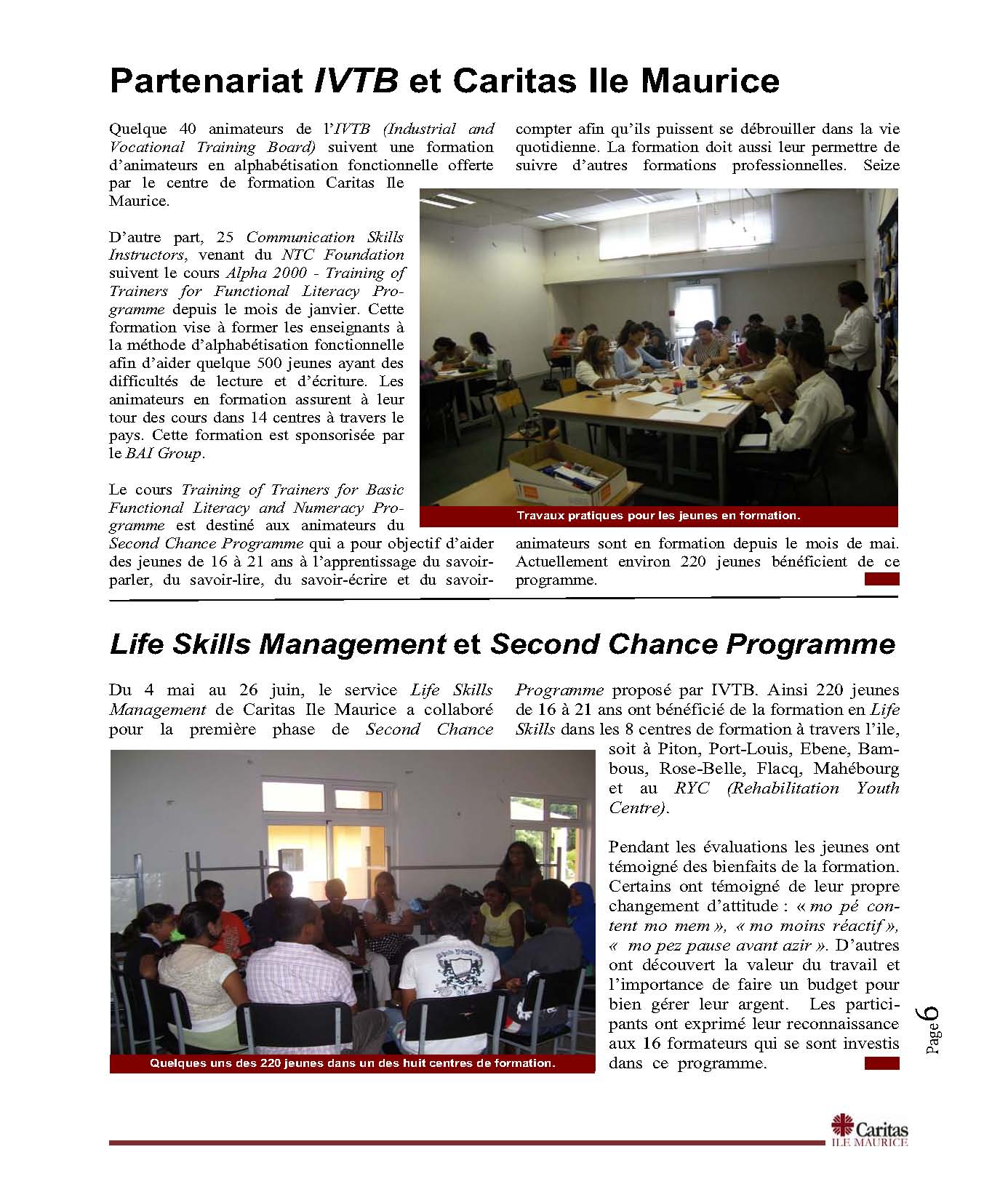
I took much pleasure in reading the second edition of the Caritas Newsletter August 2009.
What most interested me was to learn of the Caritas partnership with the government with Life Skills management and the Second chance programme.
Jean Claude de l’Estrac who was chairing the National Empowerment program re-oriented the program to start building the self esteem of the needy before training them for a job. He assesed that the original program was not yielding the results planned because of the lack of confidence of the poor of the poorest. The society has ignored them for too long, they have lost the sense of being a worthy human. Let us hope that Caritas and all those working in this field have now found the good thread!
August 5th, 2009 — Family stories
During my last visit to Montreal, Canada, I made it a duty to pay a visit to two of my mother’s cousins who now lived in Canada. It was a very emotional visit both for me and for Jessie who was a close person to my mother. More than sisters they were confidents to each other in their childhood and youth.
Mum had the misfortune to have been born in a poor family whilst her cousin Jessie was born and bred in an endowed s family. That was their fates. In the early twenties, just past the First World War, Mauritius then started to pick up economically. The steam ships restarted operating to link the various ports of the world. Port Louis was an essential halt port for the steamers serving the Eastern countries, namely China, the British colony of Hong Kong, Dutch colonies of Indonesia, the Malayan states and South Africa. Bold Chinese traders had risked their lives earlier a few decades before saw their lots improving.
Chan Chong Kwan the farther of Jessie was one of them. He moved to Mauritius as a boy of 15 around the turn of the century. He ran a retail small shop in Roches Noires area after having spent his years of apprenticeship with a prosperous Chinese a wholesaler of the capital. Some years later having saved some money he decided to move from the country side back to town to raise a family. Young Chong Kwan was a smart entrepreneur; he not only continued to maintain the countryside retail shop, he set up a wholesale shop and at the same time started with a wine factory. He married Germaine, daughter of Olezia Ah Fan and of Joseph Leong Son.
Unlike her cousin, Francette, my mother was orphan before she was born, Grand Pa, Emmanuel Ah Lim who was an employee of a Chinese gambling house, died leaving his eldest son Ignace aged 14 to look after the family of seven children. Grand Ma Anna daughter of Josephine Hitie and Mr Ahfan earned painfully a living by sewing shirts from her home to supply shops.
Solidarity amongst the members of the family prevailed. The Chong Kwan, the well to do, supported the rest of the family with clothes and in hard time money for food. On weekends and school holiday periods, the Ah Lim children stay over at the Chong Kwan in their large and spacious villa at Edith Cavell street.
Both cousins, Francette & Jessie were very close. Francette had to undergo the hardship described in one of my pervious blog to marry her love France . Hardly Jessie on the other hand was seduced by the intellectual brilliance of a newly landed scholar to the Chinese School and married Siao in grand regalia. However, few months after the wedding, Siao took the steamer back to China leaving Jessie in pregnancy. Daniel, his only son was born and for over decades, he never knew his father. Fate dictated that one cousin had difficulty in marrying and later had a harmonious family life whilst the other after a wonderful marriage had a broken family life with the absence of her husband. Indeed Siao will reappear few decades after.
August 4th, 2009 — books, learning, NLP
Ce que vous apporte la PNL
Une formation de Praticien puis de Maître-Praticien PNL permet l’appropriation de modèles de plus en plus performants
et puissants pour communiquer, apprendre et changer, au service de vos objectifs personnels et professionnels.
La communication. Les excellents communicants savent se fixer des objectifs pertinents, établir des relations de confiance,
définir des indicateurs de progression et de réussite, et faire preuve d’une flexibilité mentale, émotionnelle
et comportementale. En développant votre impact sur vous-même, vous développez votre impact sur les autres et
construisez des relations plus riches.
L’apprentissage. Réaliser nos buts dans un environnement instable nécessite un apprentissage permanent. Nous
avons besoin d’apprendre à apprendre. Apprendre en modélisant et en transférant la structure de notre propre excellence
d’une situation à une autre, ou apprendre en modélisant l’excellence des personnes qui nous entourent.
Le changement. Il permet aux individus ou organisations de trouver en permanence un nouvel équilibre entre les
exigences externes (les contraintes de l’environnement) ou internes (les valeurs, mission et vision). Un équilibre plus
aligné, plus stable et confortable, générateur d’une plus grande énergie et d’une plus grande performance.
À qui s’adresse la PNL ?
À tous ceux qui considèrent la communication et les ressources humaines comme des facteurs clé de leur performance
et de leur réussite personnelle et professionnelle, et à titre d’exemple dans les domaines suivants :
• L’entreprise : managers, commerciaux, contrôle qualité, DRH, formation, recruteurs
• Les métiers du conseil et de l’accompagnement : coachs, consultants, orientation et réinsertion professionnelle
• La pédagogie : enseignants, formateurs, éducateurs
• La santé : médecins, dentistes, infirmières et professions paramédicales
• La relation d’aide : psychologues, psychothérapeutes, assistantes sociales
Le contenu des formations PNL est facilement transposable à tous les domaines d’activité.
August 3rd, 2009 — Uncategorized
I had a lovely Sunday reading and watching videos on the Brain and the revolutionary science of neuroplasticity. The subject is of special interest to me as I suffered from brain damage after my two strokes.
For centuries the human brain has been thought of as incapable of fundamental change. People suffering from neurological defects, brain damage or strokes were usually written-off as hopeless cases. But recent and continuing research into the human brain is radically changing how we look at the potential for neurological recovery.
The human brain, as we are now quickly learning, has a remarkable ability to change itself – in fact, even to rewire itself.
Dr. Norman Doidge travels across North America to meet some of the pioneering researchers who made revolutionary discoveries about the plasticity of the human brain. He also visits with the people who have been most affected by this research – the patients whose lives have been forever changed – people once thought of as incurable who are now living normal lives.
My brother gave me the link to the different sites and videos to watch there on. Would that be a chance to better my lot? I am hopeful.
August 2nd, 2009 — Uncategorized
Jn 6,24-35.
La foule s’était aperçue que Jésus n’était pas là , ni ses disciples non
plus. Alors les gens prirent les barques et se dirigèrent vers Capharnaüm Ã
la recherche de Jésus.
L’ayant trouvé sur l’autre rive, ils lui dirent : « Rabbi, quand es-tu
arrivé ici ? »
Jésus leur répondit : « Amen, amen, je vous le dis : vous me cherchez, non
parce que vous avez vu des signes, mais parce que vous avez mangé du pain
et que vous avez été rassasiés.
Ne travaillez pas pour la nourriture qui se perd, mais pour la nourriture
qui se garde jusque dans la vie éternelle, celle que vous donnera le Fils
de l’homme, lui que Dieu, le Père, a marqué de son empreinte. »
Ils lui dirent alors : « Que faut-il faire pour travailler aux oeuvres de
Dieu ? » Jésus leur répondit :
« L’oeuvre de Dieu, c’est que vous croyiez en celui qu’il a envoyé. »
Ils lui dirent alors : « Quel signe vas-tu accomplir pour que nous
puissions le voir, et te croire ? Quelle oeuvre vas-tu faire ?
Au désert, nos pères ont mangé la manne ; comme dit l’Écriture : Il leur a
donné à manger le pain venu du ciel. »
Jésus leur répondit : « Amen, amen, je vous le dis : ce n’est pas Moïse qui
vous a donné le pain venu du ciel ; c’est mon Père qui vous donne le vrai
pain venu du ciel.
Le pain de Dieu, c’est celui qui descend du ciel et qui donne la vie au
monde. »
Ils lui dirent alors : « Seigneur, donne-nous de ce pain-là , toujours. »
Jésus leur répondit : « Moi, je suis le pain de la vie. Celui qui vient Ã
moi n’aura plus jamais faim ; celui qui croit en moi n’aura plus jamais
soif.
========================================================================
Nous, les hommes, sommes de d’êtres physique, mental, social et spirituel. Chaque dimension nommée est à être maintenue, entretenue et développée pour nous garder en état de vie. Je comprends que j’ai un besoin de me nourrir mais quid des autres dimensions ? Que veux dire maintenir mon mental, social et spirituel ?
Si j’arrête d’utiliser mes neurones ma cervelle se rétrécît et je deviens un légume n’est ce pas. Ainsi pour le social, l’interaction et les échanges avec les autres me maintient et me développe.
Tout comme tout homme a besoin de se nourrir physiquement, socialement, mentalement, pour continuer de rester en vie, nous avons également besoin de nous nourrir spirituellement. Que veux dire une nourriture spirituelle ? Un être spirituel est un être qui pense et vit au delà de sa matière d’homme. Dans ce massage de St Jean, ce matin, ‘le pain de vie’ est la nourriture spirituelle proposée par Jésus. Consommer le corps et le sang du Christ c’est ainsi se nourrir de son essence pour être en communion avec Lui, pour être transformé par Lui, pour s’abandonner à Lui, de Lui laisser vivre en nous pour en devenir comme Lui.
Je prends conscience de ce cadeau que Toi, Seigneur Christ mon Sauveur m’a laissé et aussi à toute l’humanité, ce Jeudi Saint à la Cène. Tu seras avec nous jusqu’à la fin des temps et Tu continues à nous nourrir. Comme un cercle vertueux, plus je crois en Ta présence omniprésente et Ton essence dans l’Hostie que je consomme, plus que ma foi et ma croyance en Toi grandit. N’est ce pas merveilleux ! Tout vient de toi Seigneur Dieu. Tu me demandes une infime petite initiative volontaire de penser à Toi et de croire en Toi et Tout sera fait. Amen
August 1st, 2009 — Uncategorized
Moving from ‘yes we can’ to ‘yes we do’ would be the cry of American businesses when discussing with President Obama.
It is only six months that Obama is in charge. He inherited a hefty burden, the state of the American economy was at its biggest lull as well as the state of the world economy was as it low. ‘It does take time to steer a large and heavy ship’ some may say.
So far has the Obama’s administration performed satisfactory for the business? I take great pleasure in reading the coming issue of Business week that it is dedicated to Obama & business.
July 31st, 2009 — happiness, People, Reflexion
Were the athletes of the older days better than today’s?
At the Rome event last week, only in swimming out of 32 events, 20 new world records we established. Is the physical competence of the athletes that made the difference? How much of the progress may be attributed to the improvement of the equipments and technology?
On the New York Times issue of this week, I read with great interest the debate on these issues and the ban of high tech material by the various Olympics commissions.
To my opinion, the events do not in any way minimised the performance of the great Micheal Phelps who I had the great pleasure in watching at the last Olympics in Beijing. It is normal that Phelps is out performed by others.
The technology race started with full-body suits in 2000 and progressed to the polyurethane-laced suits that helped Mr. Phelps at the 2008 Olympics. This year’s models are made almost entirely of polyurethane to reduce drag; they add buoyancy, and they squeeze the body into a streamlined shape.
Paul Biedermann, the German, swam with the latest swimwear; Mr. Phelps, with last year’s model. Mr. Biedermann didn’t just beat the American in the 200-meter freestyle, he annihilated him, finishing a body length ahead and lowering the world record, set by Mr. Phelps last year, by almost a second, an eternity in pool times.
July 30th, 2009 — Aquaculture
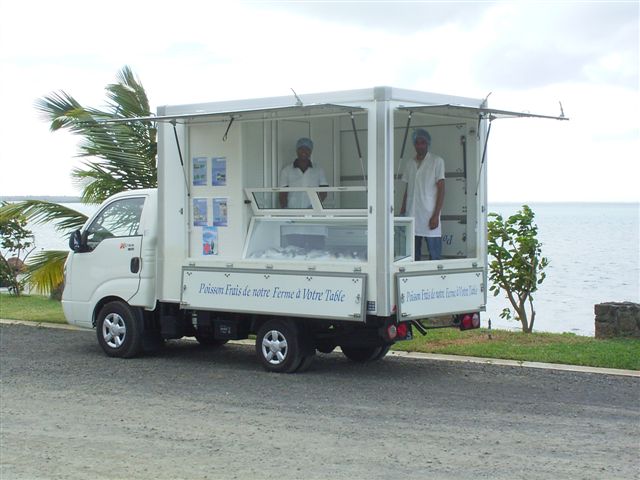
Recently I saw that the progress in quality of Fresh Fish sales. Stationed in different locations at different times fresh fish is sold in different locations of the island by a roaming truck. What a difference from the ‘Banian’, fish monger who travels on his motorcycle carting his lot of fish in his doubtfully clean basket at ambient hot temperature!
I gathered from my wife that over the radio there was again some talk on fish farming. Whilst it may be true that 6 kgs of wild fish are required to breed 1 kg of farmed fish the question to be asked is: are the 6kgs of wild fish used to make the feed consumable in form and taste to the population? On the other hand it is rumored that the feed used contain elements that are unsafe from health, some even mentioned pork meat? As far Ferme Marine de Mahebourg is concerned, after inquiry, I was assured that the feed used are to the standard of the EEC which stipulates that the farm uses feed that are natural , non toxic and animal free.
According to the FAO the share of farm fish in the world consumption is increasing. However it is necessary to regulate Fish Farming to norms that are eco friendly and to adopt practices that are development sustainable. As such, I am sure that the government who’s role is to be the watchdog has to ensure that operator’s abide to rules that are set.
Surprisingly enough, you must have heard or even seen TV documentary on the infamous breeding of Pengasius in Vietnam and in the Mekong area, and yet the European Community is still authorising the import of the fish in its territories. Is it a case of a few infamous producers that are creating adverse publicity to the healthy industry?
Mauritius is a relatively large Ocean country and its future may well be exploiting its sea potential of which Marine Fish Farming is one of them.
July 29th, 2009 — Entrepreneurship, learning
I am a regular reader of Dick McCann since 2003 through my link with Team Management System . This month he wrote an article on leadership which together with his colleague Charles Margerison, they have developed in the 90’s. I fully subscribe to the idea that a leader is after all a communicator and needs to create links at all levels.
I would like also to highlight the summary of Dick McCann on the 40 years of Popular leadership which is well documented. The references provided are treasures for the keen reader on leadership and provide sources for further studies.
I would encourage you to enrol in one of the Team Management Systems seminar to enhance your leadership skills.
Leadership Through Linking
By Dick McCann
Copyright © Dick McCann. All rights reserved.
Popular leadership theories over the past 40 years or so have been developed based on the identification of two particular phases of development of followers and associates. Blake and Mouton back in 1964 proposed five management styles based on the dimensions of initiating structure relating to the task and initiating consideration toward the individual. Low, medium and high leader behaviors on these two dimensions created the various styles. Although the conceptual clarity of the model was appealing, extensive subsequent research demonstrated that the leadership style which was most effective was not necessarily a high-high on each dimension. It all depended strongly on the situation and the challenge.
Fiedler then proposed that leadership style is a constant characteristic of each person. The challenge was therefore to match the leader and the situation. Subsequently Vroom and Yetton took the idea of a flexible leadership style further and developed a model where the appropriate style depended on the type of problem addressed. Further research by Hooijberg confirmed that were indeed strong associations between a manager’s behavior repertoire and effectiveness – suggesting that a portfolio of behaviors is the most desirable and achievable skill set.
Leadership models such as those developed by Hersey and Blanchard have also been very successful in identifying appropriate leadership styles based upon two phases of development of followers, resulting in the dimensions of Supportive and Directive leadership behavior. The idea is that most people will respond to a leadership style that has various combinations of supportive and directive behavior, depending on the situation they are in.
Supportive behaviors include:
- Listening to problems
- Encouraging and reassuring
- Facilitating followers’ problem-solving and task accomplishment
- Setting work in context
- Praising task accomplishment
Directive behaviors include:
- Setting clear goals and objectives
- Defining priorities and deadlines
- Giving precise instructions on unfamiliar tasks
- Checking and supervising
- Clear role accountability
A similar variant of this situational-developmental approach was proposed by Schein, but with a situational variable of organizational development. Each phase of an organization’s life requires a different set of responses from their leaders, depending on the organizational life cycle – young, midlife, mature, declining or rejuvenating. This focuses attention on the necessity for leaders to adapt their leadership style to the culture of the organization they lead.
However it is not only the life cycle of an organization that influences the ‘situation’. Organizational values are equally important. Some organizations value Compliance where organizational objectives are determined by senior management and rolled throughout the organization without question. Such a culture often discourages risk-taking and even the acceptance of responsibility but such an authoritarian, directive leadership style can well be effective in delivering results. Other organizations will value Empowerment and encourage the appropriate challenging of assumptions about how to do things better, thereby creating openness and confidence and an adaptive approach to leadership.
These various approaches to leadership are all dependent on ‘the situation’ and are often grouped under the heading of ‘contingency theories’. More recently they have also been grouped under the heading of transactional leadership. Such approaches assume effective leadership involves the exchange of reinforcements that are based upon established theories of social exchange, such as that of contingent reward: “If you do this for me/us, I/we will do this for you.”
By contrast, transformational leadership styles result in considerably enhanced effects on followers (Bass and Avolio). They argued that transactional – transformational leadership represents a leadership paradigm which is now supported by evidence gathered from all continents. This paradigm views leadership as either a matter of contingent reinforcement of followers by a transactional leader or the moving of followers beyond their self-interest for the good of the group, organization, or society by a transformational leader.
Transformational leader styles are not an alternative to transactional behaviors but an enhancement designed to produce increased levels of satisfaction, efficiency and extra-effort. Many studies have confirmed the efficacy of transformational leader styles in bringing about superior outcomes using independent indicators (for example, Podsakoff et al). Others have also found that managers who were better managers differed significantly from weaker managers in their use of transformational leader styles.
The Linking Leader
In the 1990s Charles Margerison and I viewed successful leadership as skill set that is primarily about relationships. Excellent leaders monitor and develop relationships among their followers and ensure that this emphasis is rolled down from their direct reports to the bottom-most layers of the organization. For us, leadership is about Linking – a set of behaviors arising out of acquired skills that encourage the coordination and integration of followers, thereby creating a unified team that knows where it is going and how to get there.
Our model is a multi-level leadership model tailored to meet the needs of team leadership. It identifies three levels of Linking that have differential effects on outcomes such as satisfaction, effectiveness, results, and extra effort. The model is cumulative in that the successful implementation of any level depends upon the level below being effectively implemented.
The three levels are shown in the Linking Leader Model below.
The outer six skills – the People Linking Skills – are the level 1 skills of successful team leadership, but they aren’t the sole domain of the team leader. The must be also be implemented by everyone in the team. These People Linking activities relate directly to the initiating consideration for the individual dimension of Blake’s grid or the Supporting dimension of the Hersey and Blanchard models. It is not surprising that the activities identified in our research align with the work of previous leadership researchers.
Level 2 skills are the five Task Linking Skills of Objectives Setting, Quality Standards, Work Allocation, Team Development, and Delegation. These relate directly to the initiating structure relating to the task of Blake’s grid or the Directive dimension of the Hersey and Blanchard models. Task Linking Skills tend to be the responsibility of the more senior members of a team who may supervise more junior team members. Such team members would be expected to successfully implement both People Linking Skills and Task Linking Skills.
Level 3 skills are the two Leadership Linking Skills of Motivation and Strategy. They relate specifically to transformational leadership skills. The team leader must implement all three levels of the Linking Leader Model in order to be fully effective.
Let’s examine briefly what I think is the most important of the Linking Skills and one that is often poorly implemented. It sounds simple but very few people do it well. It is Communication.
Communication as a cybernetic process
When we interact with others, we translate our model of the world into words and use these to attain our outcomes. These words and the supporting communication aids (tone, tempo, and body positions) very much reflect our own views of the world. Therefore when people try to communicate, there is potential for conflict to arise, as different models of the world are interacting. When opposites come together, there is a great potential for things to go wrong and the discussion or conversation may well be doomed before the first word has been uttered.
Communication is a cybernetic process, ever dynamic and constantly changing. When Person A transmits a message it travels in a forward arc to Person B who responds, and a return message is received by Person A. The response arc contains a variety of messages, verbal and nonverbal and should affect what Person A transmits next. The success of communication lies in extracting meaning from the response arc and reformulating a new forward arc that moves the conversation in the right direction. In cybernetic theory this is called ‘adaptive control’. By constantly varying the content and delivery of the transmitted message a rapport loop can be quickly established between conversing parties. This is known as the technique of ‘pacing’.
Communication loop
Cybernetic processes are governed by the Law of Requisite Variety which, stated simply, says that in any process operating systemically, the elements in the system that have the greatest adaptability or variety are those that gain control. In other words, if Person A constantly adapts their forward arc (based on the information from the response arc), they will be able to influence the results of the interaction.
Pacing is a technique for temporarily modifying your model of the world so that it matches the other person’s. This matching shows the other person that you understand ‘where they are coming from’. Unless you take time to establish ‘a pace’ early in the conversation, the chances of a successful interaction occurring are markedly reduced. Equally the person you are communicating with needs to pace you in the same way. When a ‘pacing partnership’ is established communication flows freely and successful outcomes can be generated in a surprisingly short time.
There are two types of Pacing – ‘strategic pacing’ and ‘operational pacing’. Strategic Pacing involves setting a strategy for the way you intend to structure an impending conversation, using all the knowledge you have about the other person’s model of the world. Operational Pacing is the technique to use when the conversation is actually in progress. For further information on these important concepts have a look at To help people understand and implement the concepts of Linking we have written a personal development e-learning module. This module discusses the 13 skills of Linking in much more detail and also enables you to fill in a profile questionnaire relating to another person you would like to influence. The resulting Pacing Skills Profile will give you specific tips to implement when you communicate with this person.
Exclusive offer to Learning Exchange Members
Team Management Systems is offering a free Linking With Others e-learning module (retail USD$50) to all Learning Exchange Members. Simply to receive your module. Please note that you must register before August 28th 2009 and the offer is limited to 1 module per member.
References
- Blake, R.R., and Mouton, J.S., (1964), Houston, Texas: Gulf.
- Fiedler, F.E., (1967), New York: McGraw-Hill.
- Vroom, V.H., and Yetton, P.W., (1976), Pittsburgh: University of Pittsburgh Press.
- Hooijberg, R., (1996), ‘A multidirectional approach toward leadership: An extension of the concept of behavioral complexity, Human-Relations, 49(7), 917-946.
- Schein, E.H., (1992), (2nd ed.), San Francisco: Jossey-Bass Publishers.
- Hersey, P., Blanchard, K., and Johnson, D.E., (2007), (9th ed.), Prentice Hall.
- Bass, B.M., and Avolio, B.J., (1993a), ‘Transformational leadership and organizational structure, International Journal of Public Administration Quarterly, 17.
- Podsakoff, P.M., MacKenzie, S.B., Moorman, R.H., and Fetter, R., (1990), ‘Transformational leader behaviors and their effects on followers’ trust in leader, satisfaction, and organizational citizenship behaviors’, Leadership Quarterly, 1(2). 107-142.
